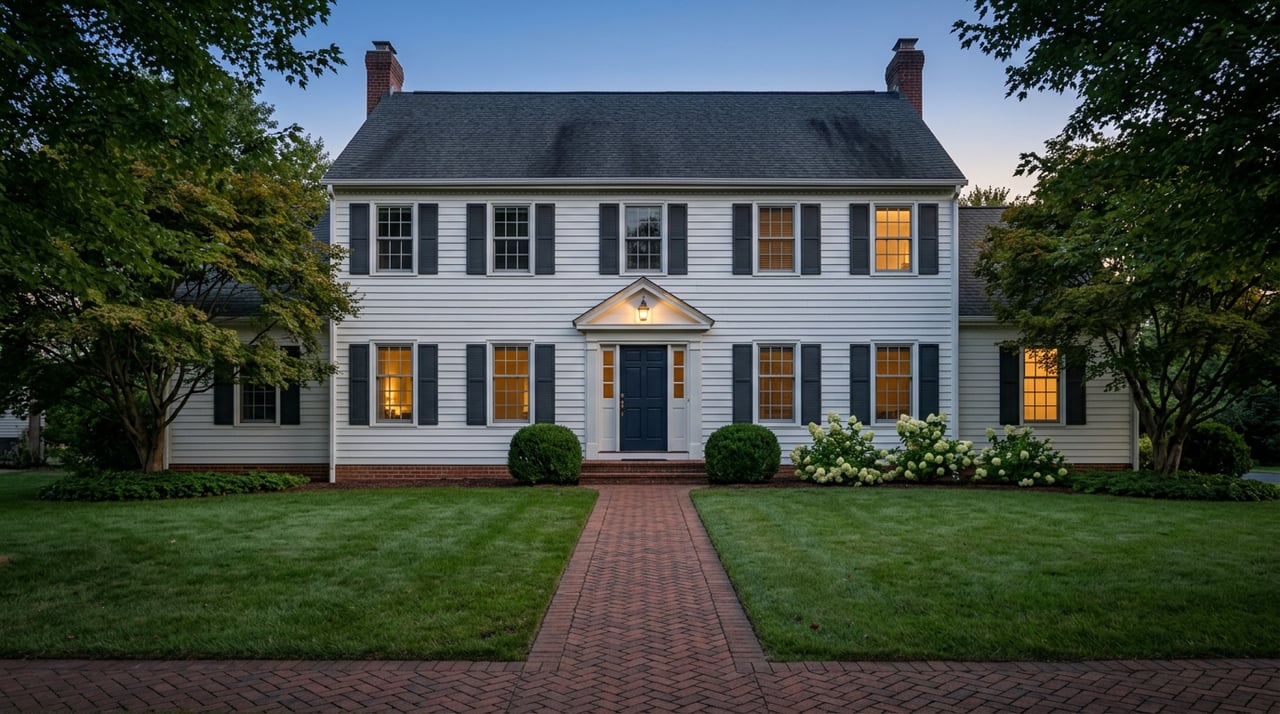
Burlington MA Property Taxes for Buyers: What They Change
August 6, 2026
August 6, 2026
A $964,000 house in Burlington and the same $964,000 house in Lexington show up on the portals as roughly equivalent. Same price, same commute band, similar bones. The listing card treats them as substitutes.
They aren't. The Burlington house costs about $3,500 less per year to own before the mortgage even starts, and the reason has nothing to do with the house.
Burlington's FY2026 residential tax rate is $8.69 per $1,000 of assessed value. Lexington's is $12.31. Bedford's came in at $12.49 for the same year. Apply those rates to a hypothetical $964,000 home, roughly Burlington's July 2026 median list price, and the annual carrying cost separates fast.
| Town | FY2026 residential rate | Annual bill on a $964,000 assessment | Monthly impact vs. Burlington |
|---|---|---|---|
| Burlington | $8.69 | ~$8,377 | — |
| Lexington | $12.31 | ~$11,867 | +$291 |
| Bedford | $12.49 | ~$12,040 | +$305 |
That $290 to $300 a month is a real number on a debt-to-income calculation. It moves the ceiling on what a buyer can qualify for. It changes how much house the same paycheck reaches.
The gap doesn't come from Burlington running a leaner budget. It comes from who else is paying.
Massachusetts lets a town apply one uniform rate to every property class or split the rate so commercial, industrial, and personal property (CIP) pays more per thousand than residential. Burlington has run a split rate for decades, and the FY2026 vote landed on a residential factor of just over 58%, which means businesses fund approximately 62% of the total tax levy even though residential parcels make up 64% of the taxable value.
The math on the CIP side underlines it. Commercial property in Burlington is taxed at $25.78 per $1,000 in FY2026, almost three times the residential rate. Office parks, hotels, the mall, District Ave, and the Middlesex Turnpike corridor absorb a share of the operating budget that residents in most peer suburbs are covering themselves.
At the FY26 classification hearing, Assistant Town Administrator Patrick Lawlor described the working brief plainly:
"Let's look at what the plan is to maintain service levels, to minimize property tax impacts for all types of property, and the key measures for projecting revenue."
That is the framework a buyer is actually inheriting. Not a rate. A political decision about how to distribute a levy, renewed at a public hearing every year.
Every town in Middlesex County can vote a split rate. Not every town has enough commercial base for the split to move the number meaningfully.
Burlington has spent fifty years accumulating one. The result is that total property values across the town have risen 84%, or roughly $4.6 billion, in the last decade, and the town has generally hit its target of pulling 1.5% of levy growth per year from new development rather than raising rates. The FY25 average single-family tax bill of $6,733 came in nearly $1,000 below the statewide average of $7,275 and roughly $3,700 below the average of comparable communities the town benchmarks against.
Bedford runs a split rate too, and its FY2026 classification pushed a 175% shift onto residential. The math still lands at $12.49, and the average Bedford single-family bill climbed to $12,985, a 9.34% year-over-year jump. Lexington also shifts, with commercial values slipping in FY26 and industrial values down 7.25%, which pushes more of the levy back toward residential.
The composition of the CIP base is doing the work. Burlington's is deeper and more diversified than most of its neighbors, and that is what the rate reflects.
The advantage is real today. It is also narrower than it was ten years ago, and the trend is worth watching if you plan to stay in the house for a decade.
Three signals are moving in the same direction. First, the residential share of Burlington's taxable value has risen from 62% to 64% over the past ten years, which means residents are shouldering a slightly larger cut of the levy each cycle. Second, the average single-family assessment has climbed roughly $220,000 in five years, to $820,300, and the FY26 average bill of $7,128 was $355 higher than the year before. Third, the town is sitting on about $15 million in excess levy capacity, meaning it can raise taxes beyond the 2.5% Proposition 2½ cap without an override. That buffer is what has absorbed rising school, insurance, and solid waste costs so far. Rising costs are steadily eating it.
None of this changes the FY2026 comparison. It does change what a 2035 comparison might look like. A buyer signing a 30-year mortgage in Burlington today is buying a favorable position, not a permanent one.
The tax gap shows up in three places during an actual transaction, and each one deserves a specific move.
Escrow math on the pre-approval. Lenders build annual taxes into the monthly payment. A buyer pre-approved to a monthly cap using Lexington-style tax assumptions will land higher in a Burlington search than they realize. Ask your lender to rerun the pre-approval with Burlington's actual rate against a target price band. In most cases, the same monthly payment reaches $40,000 to $60,000 higher in list price.
Assessment resets after purchase. Massachusetts assessors are required to assess at fair cash value as of January 1 each year. A sale materially above the prior assessment feeds directly into the next assessment cycle. If you buy well above the seller's assessed value, plan for the tax bill to migrate toward the sale price, not stay pinned to the old assessment.
Abatement window. For quarterly-billed municipalities, the abatement application typically must be filed by the due date of the third-quarter actual bill, which is often February 1. If a new assessment comes in above where comparable Burlington sales support, that window is short. Confirm the exact date with the Burlington Assessors and calendar it before closing.
Two events would compress the Burlington advantage faster than the slow erosion above. Neither is on the immediate horizon, but both are on the town's planning documents.
The first is any sustained decline in commercial values along the office and hotel corridors. Lexington's FY26 commercial and industrial slippage is the local example of what that looks like on a tax bill. If Burlington's office vacancy widens, more of the levy has to come from somewhere, and the somewhere is residential.
The second is a large capital project that exceeds the excess levy capacity and goes to voters as an override or debt exclusion. The recent failed high school building vote is the reference point. The next iteration of that conversation will land somewhere, and where it lands sets the residential rate for a generation.
Neither risk should scare a buyer off Burlington. Both should inform the assumption you build into your monthly budget.
Does the low rate mean the town spends less on services? The opposite, generally. Burlington funds free bus transportation for its schools, free trash pickup, and subsidized recreation programming inside the same levy structure. The commercial base is what makes that combination possible at $8.69.
How does the split rate interact with a residential exemption? Burlington does not offer a broad owner-occupant residential exemption, unlike Boston, Cambridge, Somerville, Watertown, and Brookline. The full residential rate applies to owner-occupants and non-owner-occupants alike. Compare that to Watertown, where the FY26 exemption is worth roughly $3,961 in annual savings for qualifying owner-occupants. Different mechanism, similar magnitude, applied to a different tax base.
Is the assessment on Zillow or a listing card the number I should use? No. The number that matters is the assessed value on record with the Massachusetts Division of Local Services as of January 1 of the current fiscal year, times the FY2026 rate. Portals lag both.
How often does the split get revisited? Every year, at a Select Board classification hearing in the fall. The residential factor is voted publicly. That vote is worth attending or reading, because it sets the next year's bill on the house you already own.
If you are comparing Burlington to Lexington, Bedford, Reading, or Winchester on a spreadsheet, the property tax line is often the difference that changes which town the numbers actually favor. Working that math against a specific price band, with a real assessment history and a lender who will run it both ways, is the difference between shopping a median and shopping a monthly payment.
When you are ready to run those numbers against Burlington inventory, Kip LeBaron can pull the assessment, sale history, and abatement pattern on any address you are considering. Let's Connect.
Stay up to date on the latest real estate trends.


Partner with a top-producing Massachusetts Real Estate Agent known for market expertise, strategic guidance, and proven results. With over 200 homes sold and $118M+ in closed sales, Kip LeBaron delivers a seamless, full-service experience for buyers and sellers across Greater Boston, Middlesex County, and southern New Hampshire.